In ancient times, people feared their gods, and the gods made the heavens, stars and earth. Gods
wrath took form of thunderbolts, with thunder and lightning with fire. Fire, that later became friend to the
ancient man. In ancient mythology, the twilight of the gods was marked by fire on Earth. Once such tales seemed mere superstition, but not any more. It seems that the ancients knew something we had forgotten until recently, that the heavens can rain fire - meteorites in today's terminology. But rocks that strike the Earth are minute percentage of the small bodies that wander between the planets in the asteroid belt, kuiper belt and the oort cloud. There are a hell lot of leftover left after the creation of the solar system that could not take form a planet or of a
satellite to a planet.
|
After 1000 million years, the young Solar System was an unstable spiral of proto-planets, planetesimals, asteroids and comets. At one time, it was taken for granted that the heavens determined human destinies. Scientific advances over the last two centuries rejected such notions as mere superstition, telling us that our Solar System was a safe and stable place in which planets, moons and comets circled according to Newton's and other laws of Physics, remote from human life. Now scientists have come to realize that we are, after all, bound to the heavens - in particular to the little objects that swing randomly between the
planets. To understand the nature of these objects, go back in your mind's eye to a time before the Earth existed.
|
|
|
|
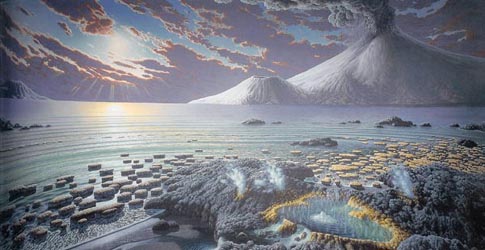
Early View
of Earth
|
|
Some 4600 million years ago, towards
the edge of our galaxy of 100,000 stars, a tenuous cloud of interstellar gas and dust was blasted out by the cataclysmic explosion of a nearby star. This particular region of the young galaxy, with its scattering of hydrogen and helium molecules, had been maturing for some 10,000 million years, steadily enriched by elements created and ejected in previous, more distant stellar explosions. At some point, a random meeting of dust and gas
produced a tiny particle that was minutely denser than its surroundings. That fractional difference
was enough for gravity to act. Steadily, it drew in nearby wisps of gas and dust, became roughly circular
and began to collapse in upon itself. The temperature began to rise from near absolute zero (-273°C) to 1000°C. Plumes of
gas carried the excess heat to what was now becoming a surface, where the gas cooled, giving off a dull glow, before gravity dragged it back towards the depths.
The gas-ball's initial slight movements became a spin, which increased in speed as the ball shrank, in much the same way as a
spinning skater's speed increases as she draws in her arms. After about 50 million years, the core of the disc
hit a temperature of 8 million .c. The hydrogen ignited and the Sun was
born. Meanwhile, the shrinking center of the gas-ball left behind swirls of gas and dust, rather like
the outer regions of a whirlpool. Under the combined effects of gravity and centrifugal force, these
swirls flattened into a disc. with the inner and outer are as
moving at different speeds, breaking up and then reforming into lesser swirls. Since any grain of
dust even a few meters farther from the Sun orbited at as lightly slower speed, the inner grains overtook
the outer ones. Drawn by gravity, they collided, some-times forming small flakes. then ever larger
objects from bodies the size of gravel, to pebbles rocks and finally mountain-sized chunks that are known as asteroids.
|
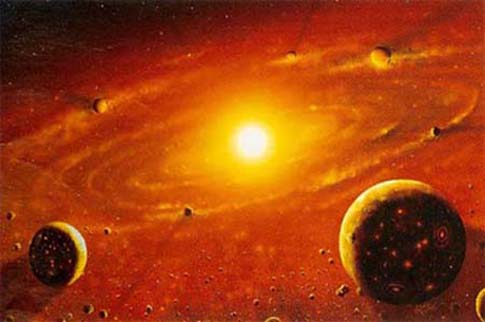 |
The
Early Solar System
|
|
|
These large block of rocks and frozen ice sometime head for the sun and take the form of deadly comets. In fact the the scientist now agree that live may get almost fully destroyed or
remarkably changed as a result of comet strike on earth. It is left to much speculation that how early round earth planet may have been broken apart due to comet strikes and the the broken earth with large chunks flown in the space that may have become moon or other nearer planets and earth itself had oceans filled with water from the frozen ice of the comet. As comets head for sun and earth being in most convenient path it may have a ancient
rendezvous for many comets. Also the grand sized outer planets, Jupiter, Saturn and also Neptune and
Uranus must have been pulling lot of these comets away from earth and thus protecting earth and hence providing the hell a lot of time that is required for evolution to take place. So the God has placed earth in the safe hand of mighty planet Jupiter and in ancient mythology Jupiter is the teacher or the wise man is in commanding position.
If the planet Jupiter was not there, the comet Shoe Maker Levy that crashed on Jupiter in 1993 may have headed for earth. The sheer pull of massive Jupiter's keeps most the asteroids and comets away from earth. The Comets have been part of our past and
constantly at risk from comets will, sooner or later, play a role in our future.
|
For a million years it was seen by man that there were no other places than the Earth.Stars were heavenly objects for him. Then in the last tenth of a percent of the total lifetime of our species, in the instant between Aristotle and ourselves, we reluctantly noticed that we were not the centre and purpose of the Universe, but rather lived on a tiny and fragile world lost in immensity and eternity, drifting in a great cosmic ocean dotted here and there with a hundred billion galaxies and a billion trillion stars. We have bravely tested the waters and have found the oceans to our liking, resonant with the nature. Something in us recognizes the Cosmos as home.
Each of us is part of an entlless drama that started billions of years ago, whena Largantuan cloud of cosmic gas and dust began to collect within the space. Then our galaxy, the Milky Way, came into being, and, within it, our solar system. The Sun is the great nucleus of this little cell, radiating incredible amounts of energy to its daughter planets, furnishing all theingredients of life and all the analogues of life that manifest themselves as simple movement and change. The story of the planets starts with the formation of the star that we call our Sun, an awesome, intricately balanced system for the conversion of matter into energy. At its centre is a nuclear furnace that converts hydrogen into helium, electromagnetic energy, and neutrinos. This energy pours continuously outward into the solar atmosphere and a brilliant corona that envelops the entire solar system.
|
|
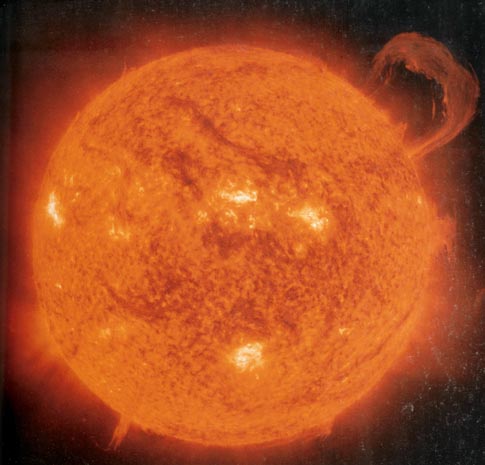 |
| Sun's
image taken by pioneer spacecraft |
| |
|
Through the millennia, people have stood in awe of the Sun, revered and worshipped it - certain modern-day tribes whose beliefs have withstood transformation by Western scientific thought or some who simply worship all in the nature, from trees to snake and sun to moon. Modern skywatchers experience at least as much wonder as they witness distant scenes with the aid of spacecraft instruments and earthbound telescopes.
Hundreds of thousands of plume of gas, called spicules, constantly surge above the Sun's surface, leaping high into the
solar atmosphere at hypersonic speed. Streamers of bright gas, prominences,
reach still higher above the solar surface, forming spectacular and large enough to encompass the giant planet Jupiter. Sometimes chunks of the Sun hurtle from the Sun into space, forming great tongues of solar debris that
disrupt electronic communications and cause aurora to fluoresce in our atmosphere. Scientifically, such huge discharges of solar material into space are known
as coronal mass ejections. In every sense, the Sun makes the solar system tick. On Earth, for
example, it is responsible for nearly every variation of the weather and climate. The Sun radiates its energy in all directions. When we consider that the planets are mere specks of matter in a solar system dominated by the Sun, we
can understand that only a tiny percentage of radiated solar energy reaches Earth.
Yet, working in partnership with the natural rotation of our planet, and it stilted orbit, the Sun's radiation helps separate night from day, winter from summer, and the tropics from the temperate and polar zones. The uneven distribution of solar energy causes wind when hot air rises and cold air
moves in to replace it. similarly, it helps move the great ocean currents. Its energy
is used by the green plants on which we and other animals are dependent for oxygen, and food. Even in a world dominated by science and technology, we feel a
great wonder at the Sun. Life as we know it would be simply inconceivable
without a star like ours.
The Beginning
We remember the great Renaissance astronomers as heroes of their
day, iconoclasts who dared to say that the Earth circled the Sun, and that
the telescope revealed more truth than the books of antiquity. But Galileo would never know of the condensation theory of galaxies, and was long buried
when its first proponent was born in Germany. The newcomer was Immanuel
Kant (1724-1804), not a true scientist but a philosopher who is credited
with conceiving the most widely accepted (and incidentally the oldest) theory
of present-day cosmology. Kant was one of those incredible prodigies of history, a frail saddler's
son with a deformed shoulder and a taste for theology, who was idolized by
the young scholars of his time. He was intrigued by connections he saw
between physics and metaphysics. Kant, while not a mathematician,
proposed that the primordial gas clouds not only coalesced into
the stars collapsing in upon themselves, as posited by Isaac Newton in1692, but also generated heat and rotation
in the process. He visualized other 'island universes', similar to the Milky Way,
existing within the cosmos. Many years later, Kant's simple. theory
was backed up after Ejnar Hertzsprung of Denmark (1873-1967) and Henry
Norris Russell of the United States (1877-1957) put together their cataloguing systems for the stars. Hertzsprung's and
Russell's systems support the idea that star systems originate with the condensation
of a scattered gaseous medium, its material provided perhaps by the
supernova explosion of a giant star. The Hertzsprung-Russell diagram, first published in 1913, is a chart
that maps star temperature on one axis and star brightness on the other.
The temperature is divided into 'spectral classes' labelled from left to right
(hottest to coolest) with the perplexing sequence O-B-A-F-G-K-M. (Astrophysicists use
the mnemonic 'Oh Be A Fine Girl, Kiss Me Right Now, Sweetheart (OBAFGKMRNS)
to remember this sequence, although the R, N, and S classes of stars have
long since been abandoned.) Because a star's color depends on its average
surface temperature, stars also change color from blue through white and yellow
to red as one moves hot to cool. Our yellow Sun is classed as a G2 star (numbers
0 to 9 are used to indicate subdivisions within each spectral class), and is
further defined as a dwarf, being of average brightness for its color. In most
aspects, the star we orbit is magnificently ordinary. The traditional view is that, at its birth about 4.6 billion years ago, the
Sun was surrounded by a churning cloud of matter, the solar nebula. As
fragments of solid matter collided and stuck together, some eventually grew into
larger objects.
On the Hertzsprung-Russell
diagram each star's position corresponds to its luminosity and its temperature.
The vertical scale represents luminosity compared to our Sun's brightness, while
the horizontal scale represents the star's surface temperature.90 per cent of all known stars
fall along the curved diagonal line called the main sequence. Above this line,
at the top of the diagram, lie the massive and short-lived super giants. Below
the main sequence one finds white dwarfs- stars that have exhausted
their nuclear fuel. Stars are not confined to the main sequence throughout
their lives. For example, our Sun will move off the main sequence, above and
to the right of its current position, as it exhausts its supplies of hydrogen
and helium and swells to become a red giant. Finally, having burned all its
fuel, it will sink below and to the left of its original position as it joins the line of white dwarfs. |
|



 Email Us




 (C) 2026 HiTech Computer Services